Roger Pielke Jr.: A Report from the Netherlands
In this article Roger Pielke reflects on his recent presentations for Clintel and his trip to the Netherlands. “Why engagement matters to me.”
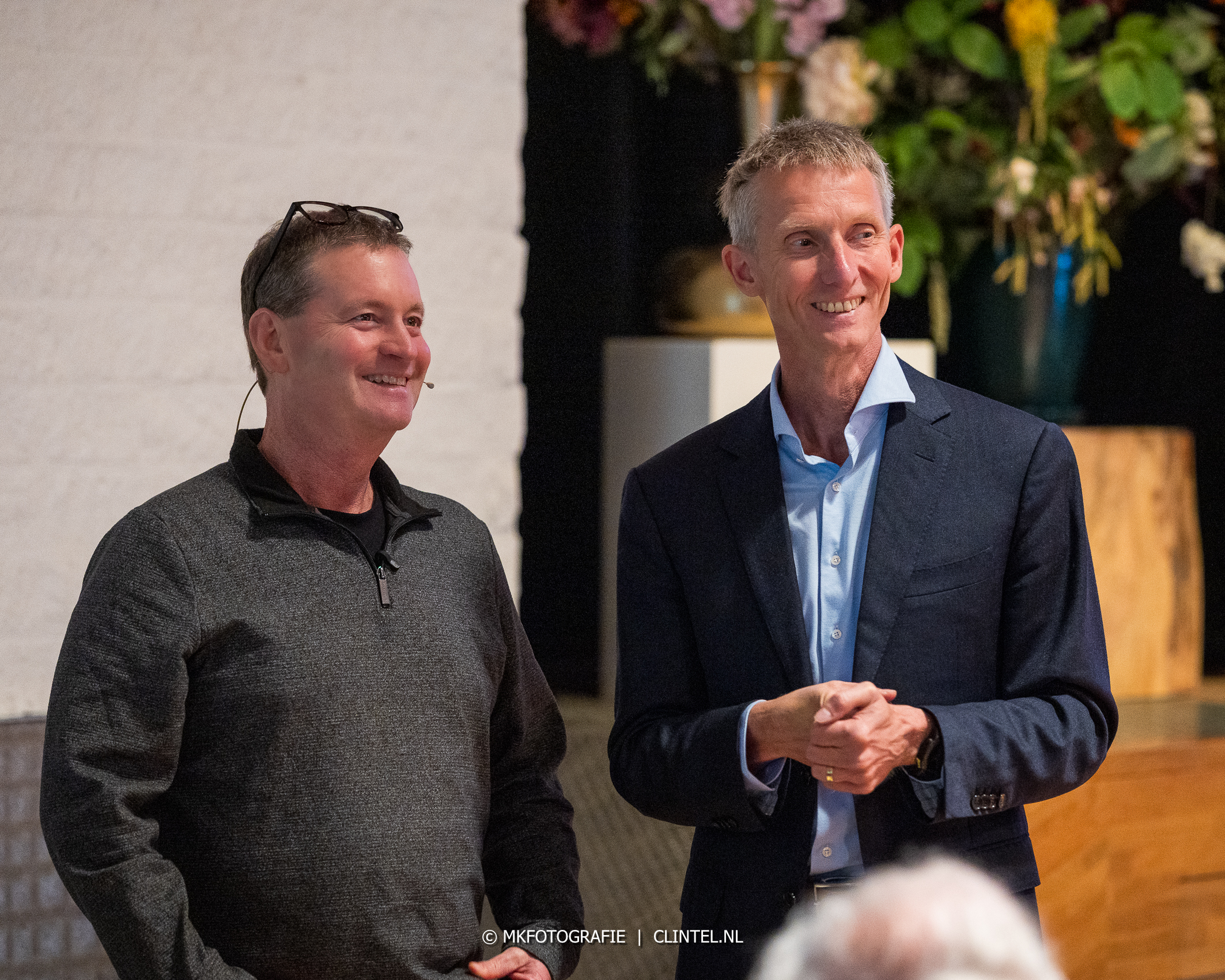
Roger Pielke and Marcel Crok in Driebergen, the Netherlands. (Photo: MKFotografie)
Roger Pielke Jr.
Date: 16 October 2026
Earlier this week I had the opportunity to speak in Driebergen, the Netherlands at an event sponsored by Clintel — which describes its perspective:
Clintel’s core view is summarized as: There is no climate emergency.
I have known Clintel’s director, Marcel Crok, for almost 20 years and am happy to call him a friend. On Saturday, Marcel took me to an Ajax match which was great fun — my first Eredivisie match, a damp 1-1 draw with NEC.
The next day, it was my pleasure to have the opportunity to speak to and with more than 200 Clintel supporters. Our conversations could have gone on for many more hours.
The discussion following my two talks and at a reception afterwards was animated, with many expressing areas of agreement and disagreement, offering their perspectives, querying me about mine, and was always good-natured.
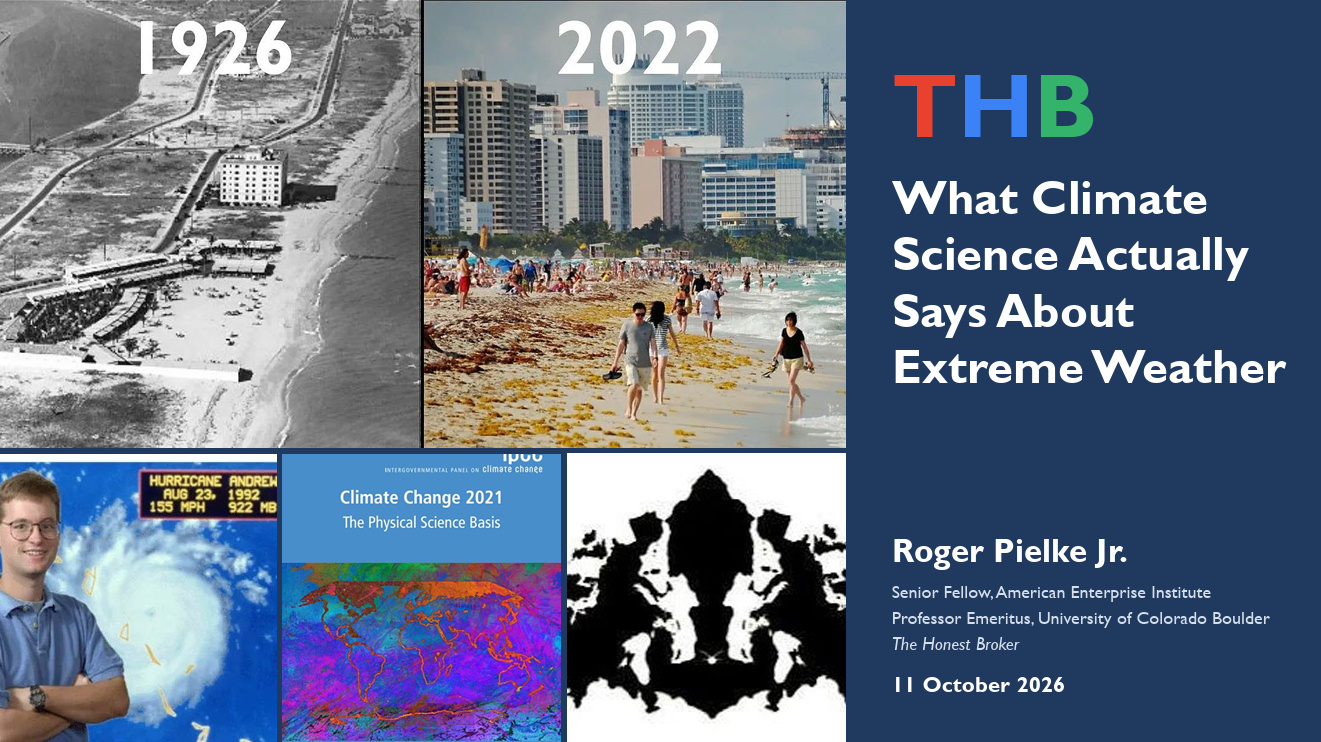
In his Clintel email newsletter, Crok acknowledged that my talk may have been provocative — pointing explicitly to the image below juxtaposing my first slide alongside the Clintel poster expressing their core view. Marcel acknowledged a tension:
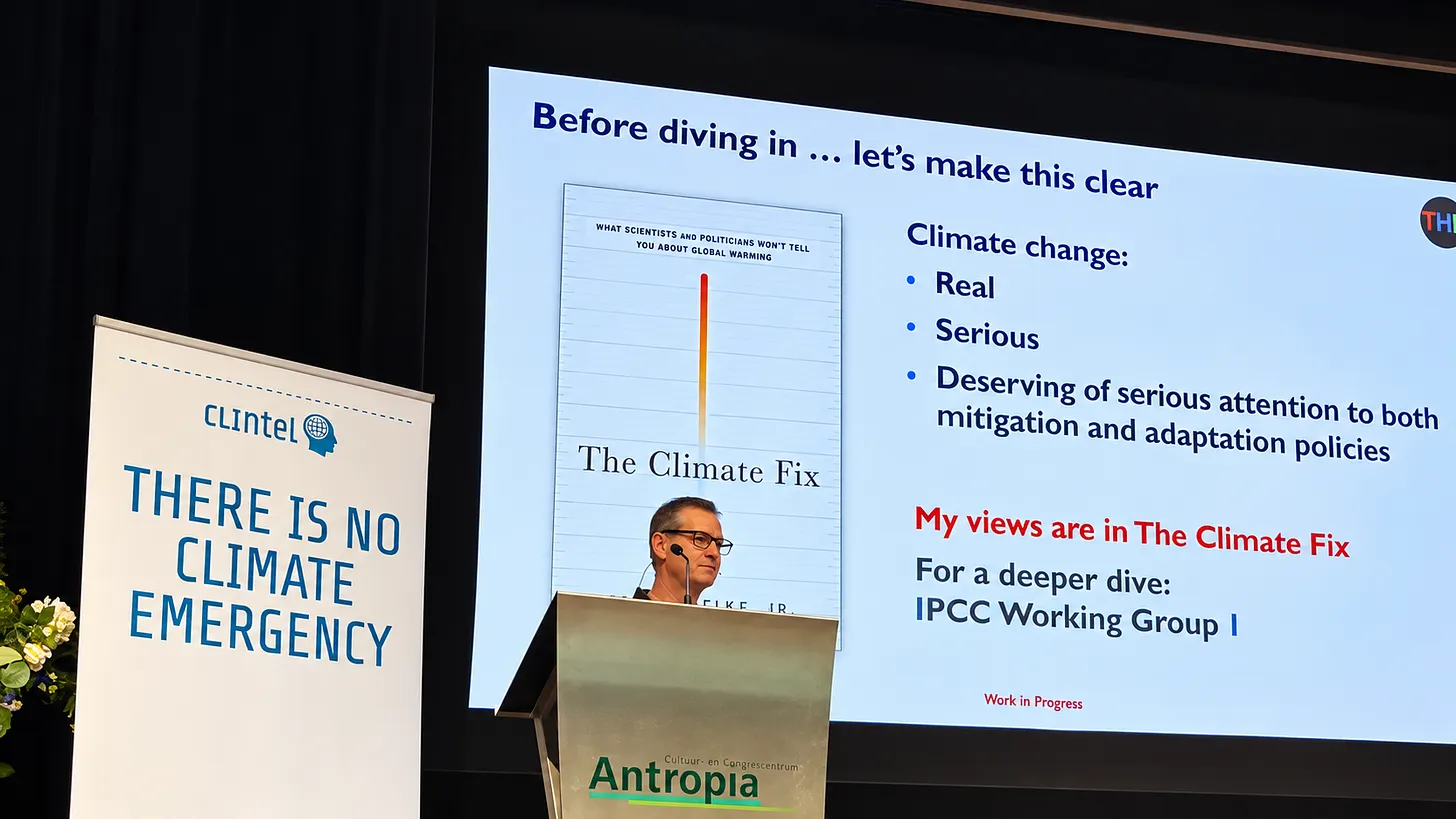
It is always interesting to see and hear how people respond to talks like these. We all interpret what we hear through the lens of our own views, and we tend to look for confirmation. When we do not find it, we can feel disappointed. The photo above was taken during Sunday’s event; it shows Pielke next to a Clintel banner. On his own X account he posted a different picture, of a slide stating that climate change is real and serious.
Many attendees I spoke to after the event openly identified as climate skeptics (a characterization that clearly did not have a single, shared understanding). More than a few told me they disagreed with my opening slide that you see above.
We then had a discussion, shared our different views, agreed and/or disagreed and hopefully achieved meaningful communication.
No blocking
Unlike the online world, no one called anyone names or blocked anyone from engagement. It was refreshing — and perfectly normal. It is the type of interaction that I think we need much more of in our polarized time.
I often hear from people — typically very online climate people — wondering why I would engage with self-described skeptics. Some, including some prominent climate scientists, claim that if I talk with climate skeptics then I too must be a climate skeptic, seemingly in an effort to discourage such engagement via public shaming and to encourage others to refuse to engage with me.
After all, why would anyone ever engage with people they might disagree with? (Insert eye-roll here).
I reject the desire for echo chambers or efforts to shame engagement through online demands for political purity.
I am happy to engage with pretty much anyone, and especially people with whom I might disagree. As a policy scholar such engagement helps me to better understand complex and contested political dynamics involving real people out in the real world. Ideally, such understandings will help me and my colleagues to develop policy proposals that are more robust to polarization and differing views of science.
Engagement, in my view, is not about winning a debate or even changing minds, but better understanding why disagreement exists and ways to turn disagreement into compromise. The goal of politics is always to reach a shared perspective on common interests and policy options consistent with those interests.
I have long believed that achieving such a shared perspective does not require everyone to view science — or facts more generally — in exactly the same way.
That’s why you’ll often hear me paraphrasing Walter Lippmann’s (Public Opinion, 1922) on the purpose of politics:
The goal of politics is not to get everyone to think alike, but to get people who think differently to act alike.
So when someone tells me they don’t think that carbon dioxide affects the climate or, alternatively, that they think carbon dioxide will cause the apocalypse — I respond the same way: I am happy to share my views on the science of climate change, but I am also happy to agree to disagree. Then I pivot to energy policy: Do you like affordable, secure, accessible, and clean energy? Two of the four? Three of the four? If so, let’s talk because common-sense energy policy that meets all four of these objectives is challenging but not impossible.
Soon on YouTube
A few days after my lectures in Driebergen, Marcel and I had a discussion at a studio — which is coming to YouTube very soon — in which we discussed our different perspectives on climate science and policy. Marcel is informed and thoughtful, and we agreed and disagreed. Most importantly, I think we communicated with each other. I am appreciative of the opportunity and the fact that we can soon share it more broadly.
It turns out, in Marcel’s words — referring to the different perspectives in the image above — that through our conversation:
[I]t became clear that our views are much closer than the two images might suggest.
I agree.
Agreement on pragmatic, sensible energy policies does not require everyone to sing from the same song sheet on climate science.
Marcel characterized my reading of the IPCC perspective, which does not include anything suggesting an emergency, apocalypse, or existential threat:
Pielke even said the debate over whether there is a climate emergency is over — and won by those who reject the emergency framing. It is time to move on from climate to energy.
Marcel also expressed some puzzlement:
One wonders why he remains so controversial. His views are largely in line with the IPCC and therefore with mainstream science.
In the Q&A following my talk, I offered Clintel some unsolicited advice:
- The debate over a “climate emergency” is over. Just look at how policy makers are acting all over the world;
- I recommend a new and positive framing for their core view, something like: the world (and the Netherlands) needs abundant energy that is affordable, accessible, secure, and clean;
- To argue against something is easy (just ask self-described climate activists), but arguing for something practical is much more productive.
For my part, I will continue to engage actively with those who might disagree with my work or views. Perhaps that is easier for me because I’m pretty sure on climate issues, pretty much everyone can find something to disagree with me on!
And that is OK — we are all better off escaping from echo chambers, engaging with a diversity of people, and subjecting our ideas to public scrutiny. Ideally, in the process, all of us sharpen our thinking and clarify how policy and politics might advance our common interests.
The fact is that the global economy has been consistently decarbonizing for more than 60 years, indicating that there is broad support for decarbonization — even if as a poorly understood outcome and not as a primary motivating goal. There are many good reasons to continue to decarbonize and to accelerate its pace, regardless of one’s view on the details of climate science.
Visit to PBL
The day after I spoke at Clintel, I had the privilege of lecturing at the Netherlands Environmental Assessment Agency (PBL) in The Hague. I gave much the same lecture there as I did in Driebergen (my second lecture there on scenarios), but it was considerably more technical for the audience of world experts in scenarios and integrated assessment modeling.
There too we had a fantastic discussion, with areas of agreement and disagreement in a healthy environment of respect and collegiality — again, what should be perfectly normal. I left with a better understanding of their views and hope the reverse was achieved as well. It turns out there was far more agreement than disagreement.
Thanks again to Marcel, PBL, and everyone in the Netherlands who welcomed me to engage, debate, and share some football, wine, and beer — Tot de volgende keer!
This article was published first on The Honest Broker on 15 October 2026.
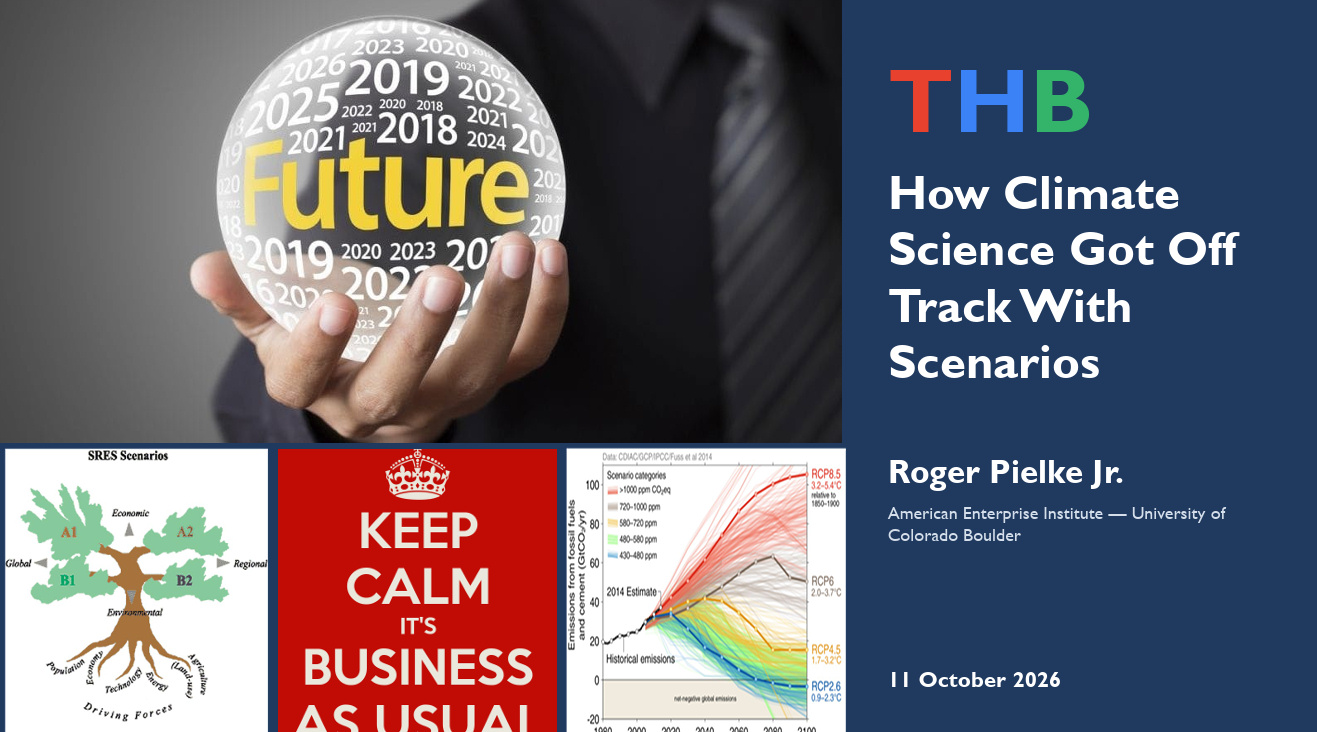
Please have a look at these two lectures, presented by Roger Pielke Jr. at the Clintel meeting in Driebergen, the Netherlands on 11 Oktober 2026:

Roger Pielke Jr.
Roger Pielke Jr. is an American scientist and expert at the intersection of science and policy. He writes critically about climate policy and the role of science in public debate, and is known for his level-headed, data-driven analyses. Pielke was a professor at the University of Colorado Boulder and is concurrently a Senior Fellow at the American Enterprise Institute. He now also publishes via his Substack page, The Honest Broker.
The article you have just read was made possible by our donors.
Every day, Clintel publishes articles on climate, energy and science. We also translate and share international analyses in multiple languages, produce videos, publish reports and organize conferences and events around the world.
We receive no government funding and rely entirely on the support of our donors. Your support helps us promote independent research and contribute to a more open and balanced debate on climate and energy issues.
Would you like to support our work? Choose the option that suits you best:
• Become a Friend of Clintel – support us with an annual contribution
• Make a recurring donation – provide ongoing support and help us plan ahead
• Make a one-time donation – every contribution helps
Thank you for your support.
more news

How Much of a Threat Are Melting Ice Sheets and Glaciers?
The recent tragic Himalayan flash flood (the source was actually a landslide of the underlying bedrock) has brought to the fore an important question, says Ralph Alexander. How much do we need to be concerned about melting ice, from both glaciers and ice sheets?
Norway keeps on drilling in the Arctic
Norway’s Minister of Energy Terje Aasland has told Reuters that his country will keep developing oil and gas in the Barents Sea irrespective of a European Union (EU) ban on Arctic drilling.

Was 2026 really the “hottest summer on record” in the United States?
Summer 2026 was the “warmest on record” in the US based on average daily temperatures. But not when measured by average daily maximum temperatures, says Chris Martz. Furthermore, there are legitimate concerns about the adjustments NOAA applies to its raw data.