
COP30 Is Lying To Justify Its Existence
COP30 is building its case on climate misinformation that rewrites the past to claim a victory it never earned.

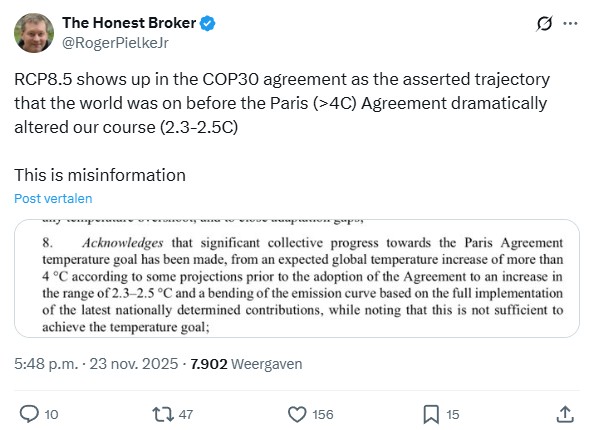
The COP30 agreement claims the world was previously on track for more than 4C of warming until the Paris Agreement heroically “bent” that trajectory down to 2.3–2.5C:

However, “this is misinformation,” says Roger Pielke Jr., Professor of Environmental Studies at the University of Colorado Boulder. It is a fiction built on the carcass of RCP8.5 — the extreme scenario that scientists quietly abandoned years ago because it required impossible coal use, implausible demographics and an economic collapse that never happened.
COP30 is resurrecting an unrealistic, disowned scenario in order to claim that Paris saved the world. The problem is the data. Real-world emissions show no curve bending, no slowdown and no “Paris effect”.
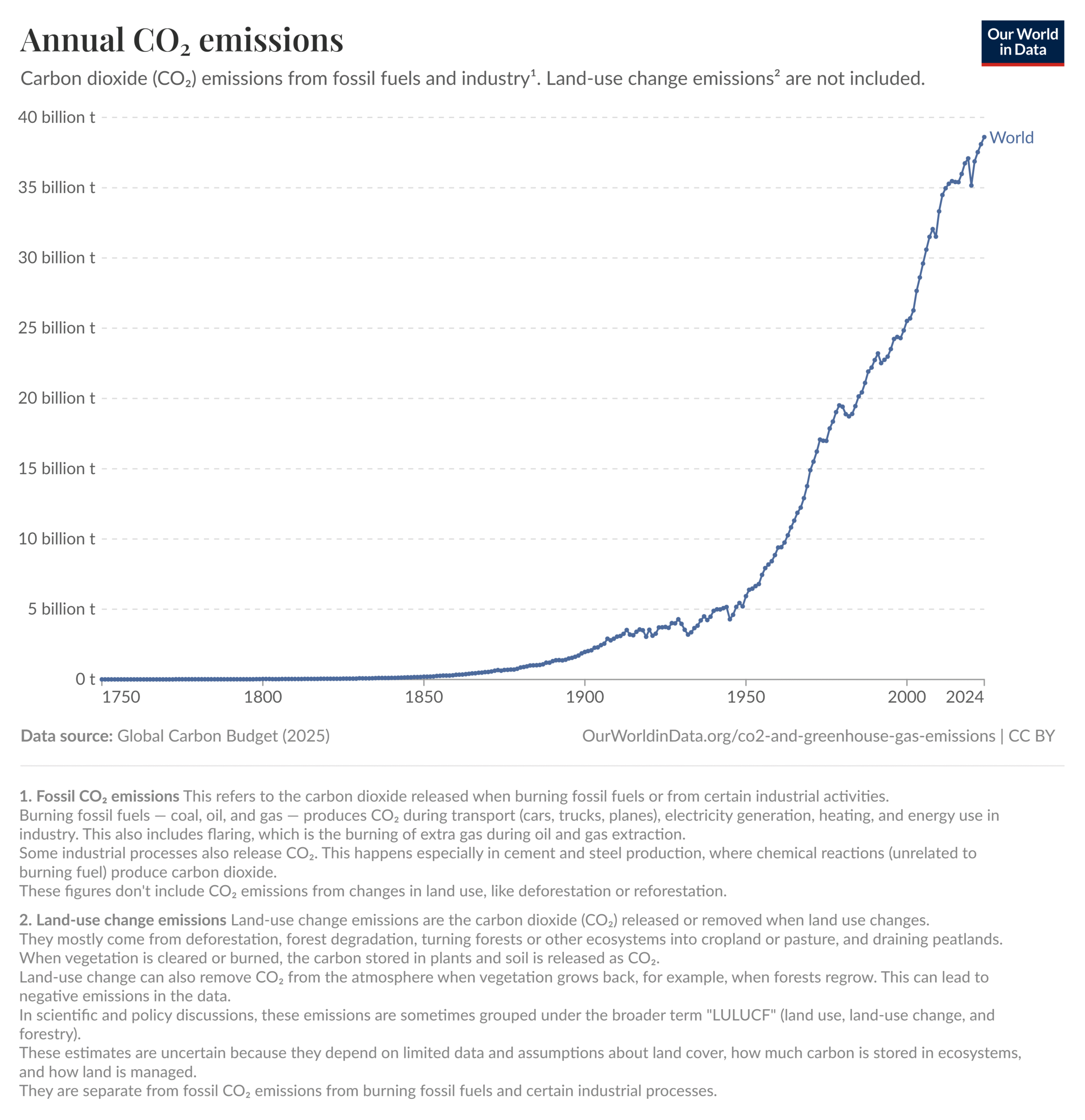
Paris didn’t change emissions, but it did unlock a permanent justification for climate taxation, energy rationing and the dismantling of cheap, reliable power — the foundation of economic prosperity.
COP30 needs a victory to justify its existence. So it has rewritten history: invent a 4C trajectory, pretend Paris knocked it down, and congratulate itself for saving humanity.
The world was never heading for RCP8.5. Paris didn’t change emissions.
Lies.


more news

Clintel President Václav Klaus warns: “No radical change in Europe in the near future”
We must not be naïve optimists about climate policy and should not overestimate the recent positive signals, like those from President Trump. This is the view of Clintel President Václav Klaus: “Nothing has changed in the European Union. We, with a background in the social sciences, cannot imagine that any radical change will take place in Europe in the near future.” Klaus made these remarks in his speech at the annual meeting of the Norwegian Klimarealistene in Oslo on March 15.

New study finds low CO2-sensitivity again
A new paper by Frank Stefani compares solar variability and CO₂ emissions as drivers of global sea surface temperatures. Using the solar aa geomagnetic index alongside CO₂ data, the study estimates a transient climate response (TCR) of about 1.1–1.4 K, near the lower end of the IPCC range. The results align closely with other observation-based estimates and highlight the continuing scientific debate about the relative roles of solar activity and greenhouse gases in recent climate change.
Clintel Ambassador Ian Plimer on popular Triggernometry podcast: “Climate science is the biggest cult in scientific history”
Clintel-ambassador for Australia, prof. Ian Plimer, didn’t hold back in his recent interview on the popular Triggernometry podcast: “There’s a very large body of people out there who are actually using science to promote scams. It’s absolutely crippling Western countries. You can’t run an industrial society on sea breezes and sunbeams.”

