
No, BBC, Disaster Losses Can’t Be Tied to Climate Change
Presenting trillion-dollar model outputs as settled economic fact is bad journalism and the BBC should be ashamed for presenting such easily falsified rubbish as fact. That’s the true disaster here.

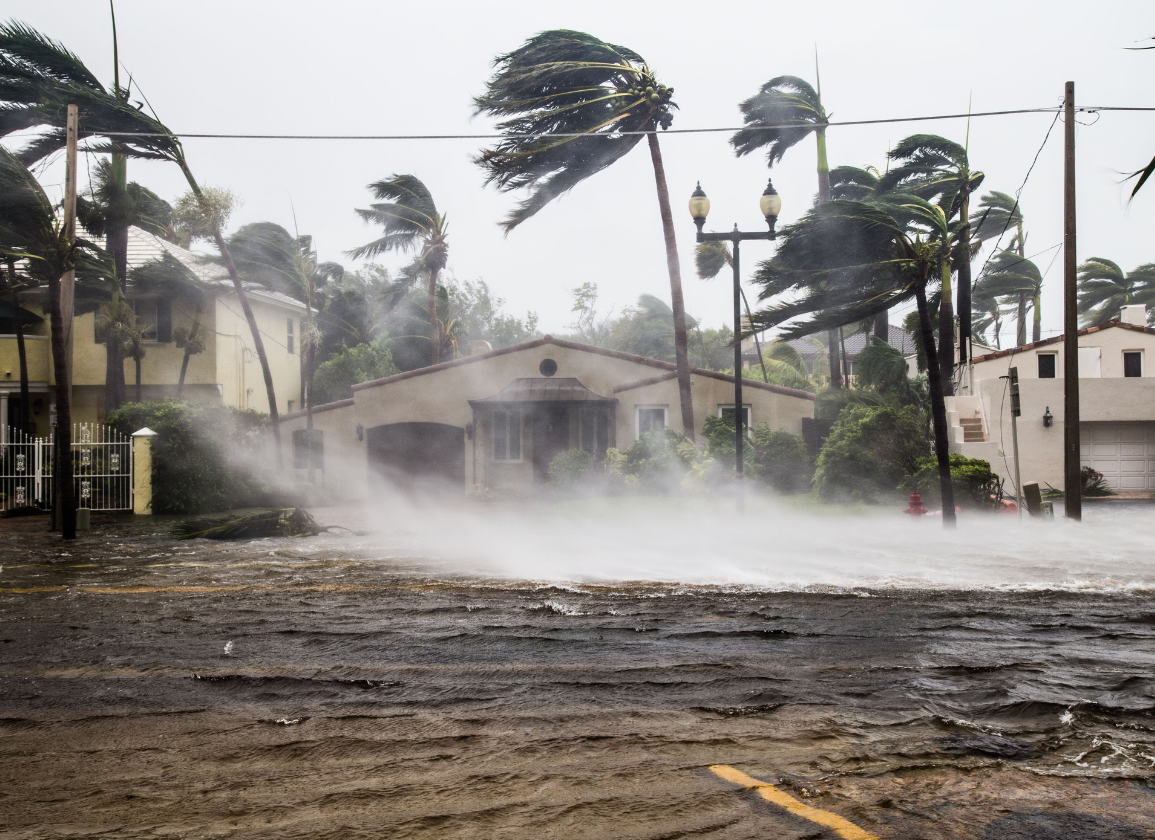
A flooded street after Hurricane Irma hit Fort Lauderdale (2017). Source: Shutterstock
Anthony Watts
Date: 14 April 2026
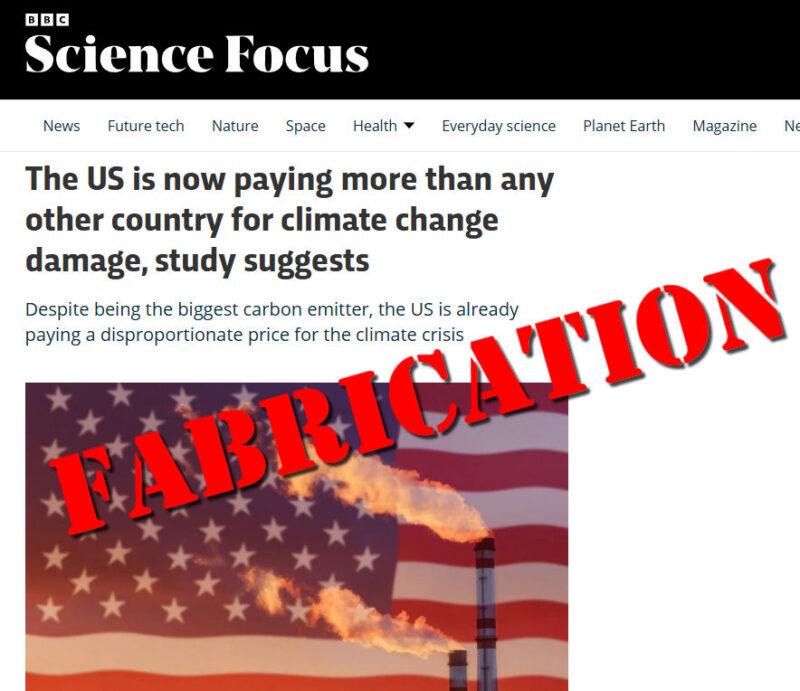
The recent British Broadcasting Corporation (BBC) Science Focus publication “The US is now paying more than any other country for climate change damage, study suggests,” claims that the United States is “now paying more than any other country for climate change damage,” citing a study estimating $16.2 trillion in U.S. losses since 1990. This is a fabricated falsehood. Decades of peer-reviewed research on disaster losses show no detectable long-term trend in normalized weather-related losses attributable to human-caused climate change and the BBC is wrongly conflating weather with climate.
The BBC based its story on a study from researchers at Stanford University, who write “[c]limate change is causing measurable harm globally.” They admit that no research links loss and damages from extreme weather to climate change; a gap in knowledge they attempt to remedy by applying politically motivated, flawed social cost of carbon estimates to econometric models tying carbon dioxide emissions to aggregate economic output in simulations of what output might have been had the Earth not warmed slightly.
The study’s model-derived GDP estimates don’t, as the BBC story implies, represent documented observed damages. There is a critical distinction between econometric modeling and real-world loss data.
Roger Pielke Jr., Ph.D., in his 2023 comprehensive review “Climate Change and Disaster Losses,” surveyed the peer-reviewed normalization literature and found overwhelmingly that increases in reported disaster losses are explained by increased exposure, wealth, and development—not by climate change.
That is not a fringe claim. It reflects the dominant conclusion in existing scientific literature.
Normalized
As Pielke explains in the abstract of his 2020 paper, understanding disaster losses requires separating climatic changes from societal changes. When losses are “normalized” to account for inflation, population growth, and expanded infrastructure, the upward trends largely disappear. His review examined 54 normalization studies published between 1998 and 2020 and found “little evidence to support claims that any part of the overall increase in global economic losses documented on climate time scales is attributable to human-caused changes in climate.”
Also in his publication, Pielke summarizes the Intergovernmental Panel on Climate Change (IPCC) Fifth Assessment Report (AR5) conclusion that “loss trends have not been conclusively attributed to anthropogenic climate change.” That statement alone directly contradicts the BBC’s framing.
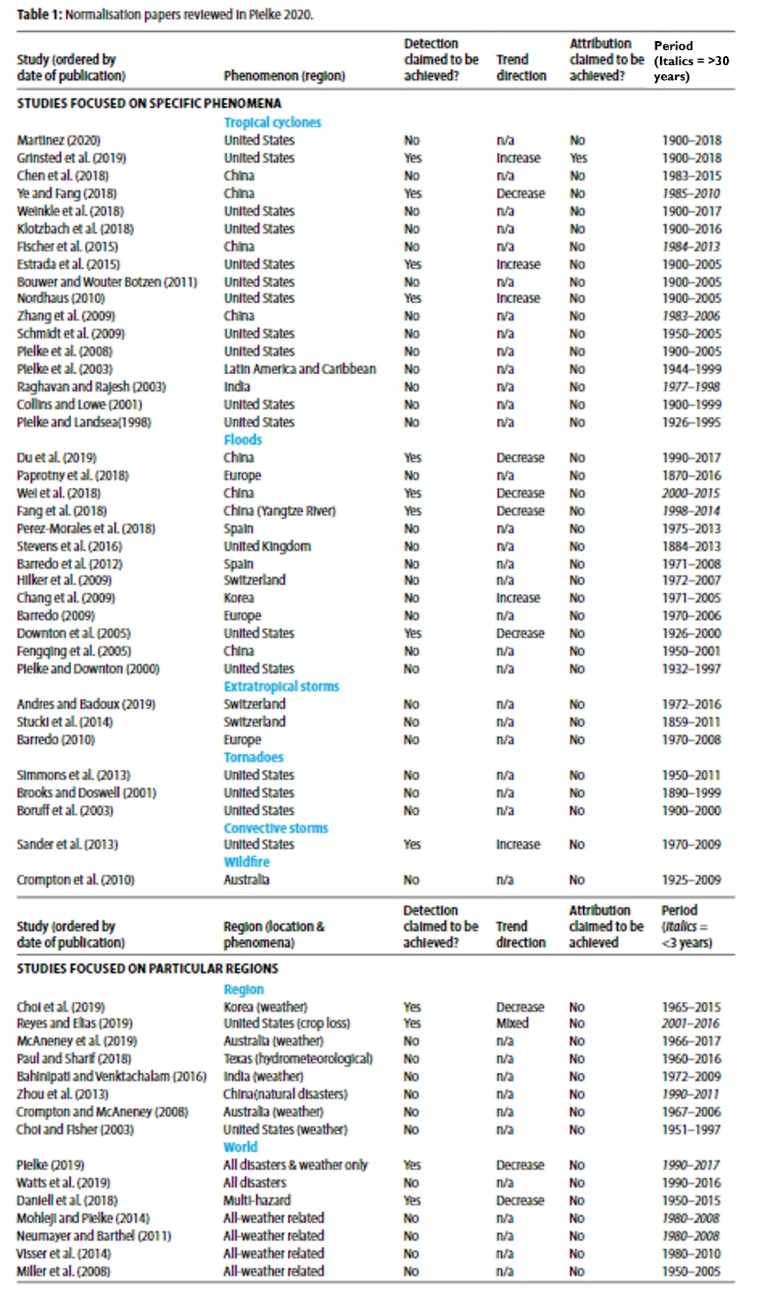
The visual tables Pielke published in his 2023 review, particularly the normalization summary table (seen below,) demonstrate that across hurricanes, floods, extratropical storms, tornadoes, and wildfire, the majority of peer-reviewed studies report no detection of trends in normalized losses and no attribution to greenhouse gas emissions.
More property
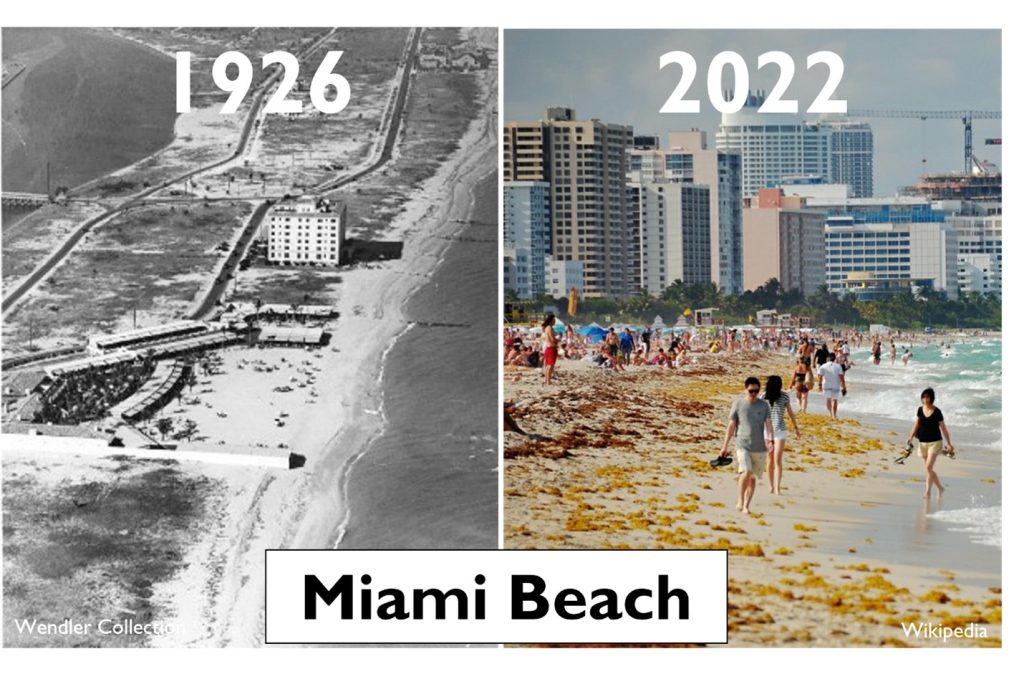
In fact, as updated through 2023, Pielke identifies 62 relevant normalization studies worldwide, and 61 of them make no claims of attribution. Normalization is essential because economic losses increase as societies become wealthier and more built out. A hurricane striking Florida today hits vastly more property than one striking the same coastline in 1950 or earlier. That does not mean the storm is stronger. It means there is more damage because more people have populated coastal areas and more real estate infrastructure exists there compared to decades before. Florida’s population was just over 2.7 million in 1950, but exceeded 23 million by 2024. The number of homes in Florida has grown from roughly 600,000 in 1950 to over 10 million today, leading to a much higher density of assets in high-risk coastal areas.
In a 2022 substack post, Pielke showed how different Miami beach has become in just under 100 years, and how much more infrastructure exists.
Pielke published a second peer-reviewed paper in 2024 in the scientific journal Nature, and included this graph below.
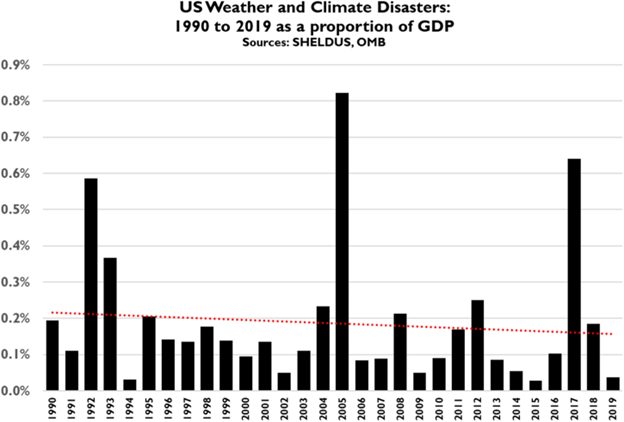
That downward trend is an overwhelming scientific fact against the position the BBC holds.
The BBC article’s trillions-of-dollars claim rests on counterfactual GDP modeling, not on normalized disaster loss data. It extrapolates temperature–GDP relationships and then assigns financial liability across countries. That approach assumes temperature deviations directly and measurably suppresses economic output in a way that compounds over decades. It does not isolate actual disaster damages; it models hypothetical economic worlds.
Vanish
In contrast, normalization studies examine real disaster loss data adjusted for societal growth. When that is done, long-term trends largely vanish.
Pielke is explicit that the lack of detection or attribution in disaster losses does not deny climate change. It simply reflects what the empirical literature shows. There is no statistically robust signal in normalized disaster losses that can be attributed to greenhouse gas emissions.
This is entirely consistent with the IPCC Sixth Assessment Report (AR6), which continues to acknowledge large uncertainties in linking aggregate economic losses to anthropogenic climate change.
Observed normalized disaster losses do not support the claim that the United States is uniquely “paying more than any other country” due to climate change. The growth in economic losses over time is overwhelmingly explained by growth in wealth and exposure.
When peer-reviewed normalization studies are examined collectively, the pattern is clear. There is no detectable, attributable upward trend in disaster losses driven by greenhouse gas emissions.
In fact, U.S. GDP has grown considerably during the recent period of slight global warming. The opposite should be the case if climate change was causing multi-trillion dollar economic losses. In fact, the study can’t tie a single extreme weather event explicitly to human emissions or the losses that were incurred. The losses are all in computer simulations, not borne out in the real world.
Presenting trillion-dollar model outputs as settled economic fact is bad journalism and the BBC should be ashamed for presenting such easily falsified rubbish as fact. That’s the true disaster here.

This article was published first on climaterealism.com on 10 April 2026.

Anthony Watts
Anthony Watts is a senior fellow for environment and climate at The Heartland Institute. Watts has been in the weather business both in front of, and behind the camera as an on-air television meteorologist since 1978, and currently does daily radio forecasts. He has created weather graphics presentation systems for television, specialized weather instrumentation, as well as co-authored peer-reviewed papers on climate issues. He operates the most viewed website in the world on climate, the award-winning website wattsupwiththat.com.

more news

Supreme Court Justice Gave Bogus Science a Blind Endorsement
Supreme Court Justice Elena Kagan has written the foreword for the Federal Judicial Center’s Reference Manual on Scientific Evidence without reading a chapter on climate change that was eventually removed – and has yet to read it.

EU’s Pretense of ‘Transition’ Leadership Is an Economic Loser
The European effort to advance renewables is incinerated almost instantly by the combustion of fossil fuels elsewhere, says Samuel Furfari. It also leads to economic decline.

Is Britain’s New Energy Secretary Even Crazier than Mad Ed?
The new Energy secretary of the UK, Miatta Fahnbulleh, wants full Net Zero by 2030.

