Orwellian Sacking of Editor for Allowing Debate Over Climate Change
An academic editor has been dismissed after publishing research that challenges mainstream climate discourse, raising serious questions about the state of open debate in science and media.
Andrew Sibley
Date: 6 November 2025
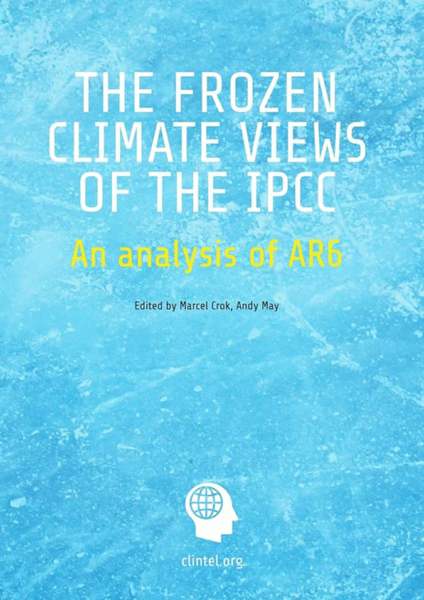
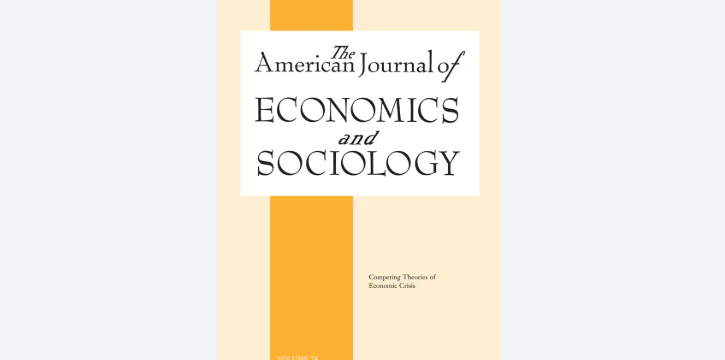
The Special Issues Editor of the American Journal of Economics and Sociology has been sacked from his position for daring to allow debate over the impact of climate change. Environmental Engineer Dr Marty Rowland was removed from his position for publishing a paper by Marcel Crok and Andy May. The paper for a special issue (published online May 29th 2024) was entitled: ‘Carbon Dioxide and a Warming Climate Are Not Problems.’ It was widely read, becoming the second most popular paper in the 83-year history of AJES. The action against Dr Rowland was reported by Andy May in August 2025; the former editor described his removal as “Orwellian”.
The paper makes the claim that the current and future impact of global warming is exaggerated in the IPCC reports and that it ignores the harmful impact of the cold climate of the pre-industrialised era. In addition, the IPCC erroneously reports that climate change is dangerous; for example, the 6th IPCC Assessment Report (AR6 WGII 2022) asserts that human activity
has caused widespread adverse impacts and related losses and damages to nature and people, beyond natural climate variability. … The rise in weather and climate extremes has led to some irreversible impacts as natural and human systems are pushed beyond their ability to adapt (high confidence).
Instead, in their paper, Crok and May argue that the apparent warming from the mid-19th century has a net benefit, because the world was in a “very cold and miserable” period during the Little Ice Age, which lasted from about 1300 to 1850. This fact is generally ignored by the IPCC reports. More people die from extreme cold than heat. The authors state that the Little Ice Age
was a very cold and miserable time for humanity, with a lot of well documented extreme weather in the historical record from all over the Northern Hemisphere. It was also a time of frequent famines and pandemics. Arguably today’s climate is better than then, not worse.
The examples they cite include a reduction in areas prone to drought and no evidence of an increase in hurricane activity. They might also have noted a net greening, as reported by the IPCC itself in its ‘Special Report on Climate Change and Land 2019‘. Crok and May state that: “Observations show no increase in damage or any danger to humanity today due to extreme weather or global warming.” Given their claims, that severe weather has not increased with global warming and arguably the present climate is more benign than the pre-industrialised one, it seems perverse to drive the world towards net zero carbon emissions. This is especially so when there is an ongoing abundance of inexpensive fossil fuels and policies to tackle climate change are prohibitively expensive.
The most vociferous response to Crok and May’s claims was in a paper by Tinus Pulles, entitled ‘Climate Denialism‘, which seems to have swayed the editorial board to remove Dr Rowland from the journal. Pulles accuses Crok and May of engaging in logical fallacies and “rhetorical tricks”, such as use of “fake experts, cherry picking, creating false expectations and misrepresentations of available understanding”. Andy May responded to this criticism by pointing out that there are many false statements in Pulles’s critique, and some of the citations even compared climate sceptics to Holocaust deniers. In a detailed response May claimed that:
There are 20 clearly false statements and three additional problematic statements in Tinus Pulles’s ‘Climate Denialism’. Most of them stem from disagreements on how to interpret existing data. However, some are due to his lack of understanding of what we wrote, or intentional distortion of what we wrote.
May and Crok reported to the College Fix that there was pressure to retract their paper, and that the publisher, Wiley, wanted to censor it because of disagreement with the conclusions. However, critics have been unable to identify any errors, which is why it hasn’t been retracted by the journal board. The editorial team did however respond by firing Dr Rowland instead, which sends a warning signal to those who may be tempted to ‘rock-the-boat’ in future. May told the College Fix that:
The pressures are huge. Basically, if a climate researcher does not toe the ‘consensus’ line he will receive no funding for his work and will be ostracised. He or she is then often forced to resign or fired.
Once again, we see the political pressure in academia to follow the consensus line on climate research or face the consequences. The economic impact on society is that climate policy has become detached from observational science, driven by ideology, together with huge subsidies for ‘green’ energy. The impact for science is one of loss of integrity and a decrease in trust when editors are removed simply for allowing a debate. The forced consensus on climate change is damaging to science.
Andrew Sibley is a semi-retired Chartered Meteorologist with an MSc in Environmental Decision-Making and an MPhil in Theology. This article was published on 2 November 2025 on The Daily Sceptic.

more news

Measuring Meaningless Climate Actions
What would Americans gain from eliminating every ton of carbon dioxide emitted from the use of fossil fuels in the United States? The answer, says Vijay Jayaraj, is nothing.

“Amendment to Climate Assessment is only a first step”
“Amendment to Climate Assessment is only a first step” The Trump administration has proposed an amendment to the U.S Fifth National Climate Assessment that acknowledges its emission forecasts are implausible and must not guide federal policymaking. This is a welcome restoration of scientific integrity, says executive director Angela Wheeler of the CO2 [...]

Jonathan Cohler: “The rise in atmospheric CO2 is not caused by humans.”
Physicist Jonathan Cohler has put forward a controversial and uncompromising challenge to one of the central assumptions of modern climate science and policy. He argues that the rise in atmospheric carbon dioxide over the past few decades is not due to human emissions, but is the result of natural processes.