
COP30 Is Lying To Justify Its Existence
COP30 is building its case on climate misinformation that rewrites the past to claim a victory it never earned.

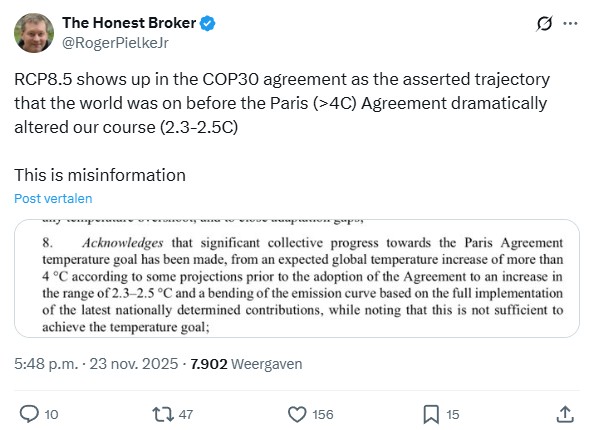
The COP30 agreement claims the world was previously on track for more than 4C of warming until the Paris Agreement heroically “bent” that trajectory down to 2.3–2.5C:

However, “this is misinformation,” says Roger Pielke Jr., Professor of Environmental Studies at the University of Colorado Boulder. It is a fiction built on the carcass of RCP8.5 — the extreme scenario that scientists quietly abandoned years ago because it required impossible coal use, implausible demographics and an economic collapse that never happened.
COP30 is resurrecting an unrealistic, disowned scenario in order to claim that Paris saved the world. The problem is the data. Real-world emissions show no curve bending, no slowdown and no “Paris effect”.
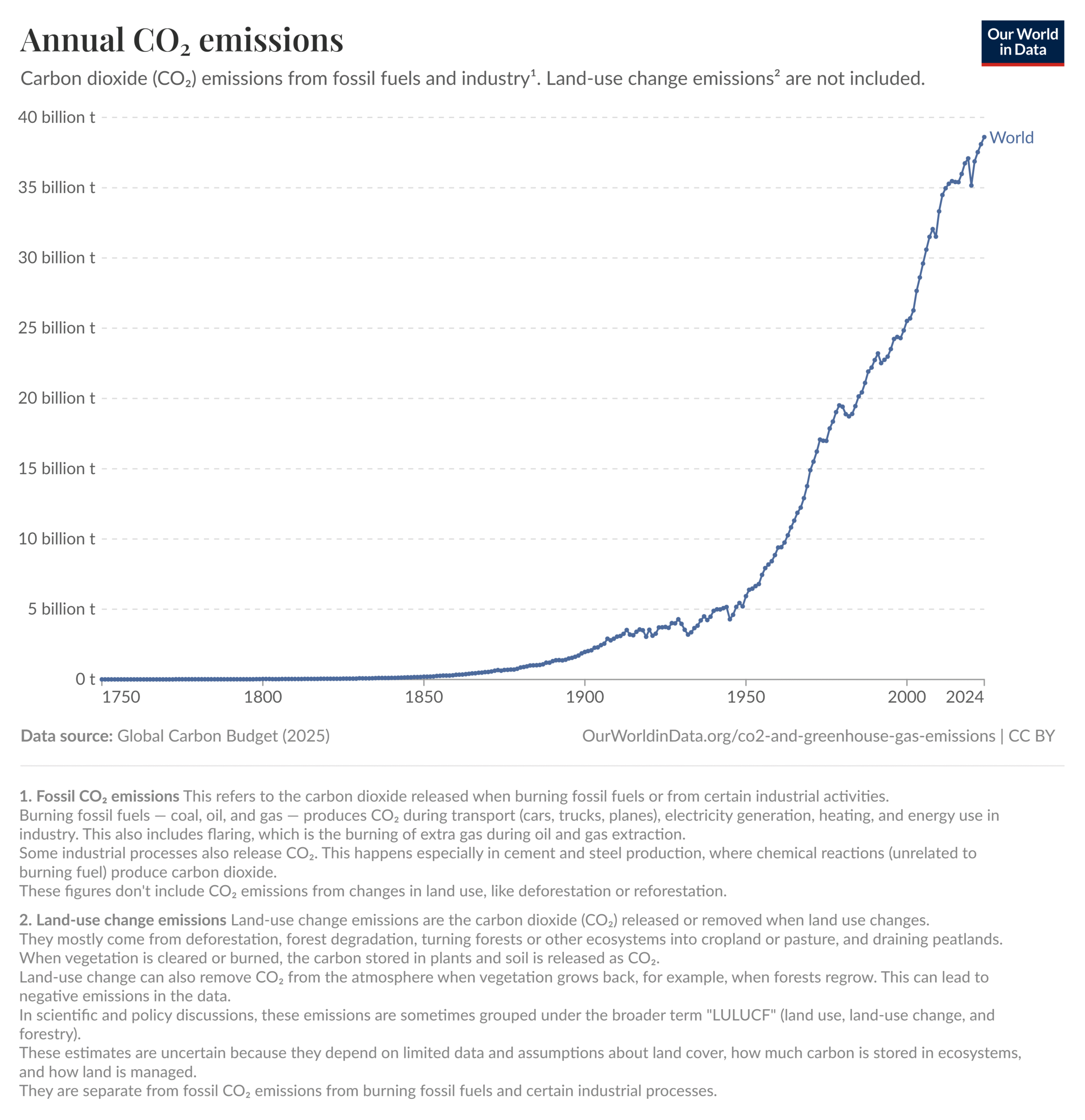
Paris didn’t change emissions, but it did unlock a permanent justification for climate taxation, energy rationing and the dismantling of cheap, reliable power — the foundation of economic prosperity.
COP30 needs a victory to justify its existence. So it has rewritten history: invent a 4C trajectory, pretend Paris knocked it down, and congratulate itself for saving humanity.
The world was never heading for RCP8.5. Paris didn’t change emissions.
Lies.


more news

The Polar Bear Narrative: What Scientists Knew Before Frozen Planet Aired
In 2011, BBC viewers were told that polar bears in the Barents Sea were starving due to climate-driven sea ice loss. Later scientific evidence shows that this portrayal was inconsistent with data already available at the time.

Why Is the Southern Ocean Cooling? Three New Scientific Explanations Challenge Climate Models
Surface temperatures in the Southern Ocean around Antarctica have cooled for decades, defying the projections of leading climate models and puzzling researchers worldwide. In this article, physicist Ralph B. Alexander examines three recent studies that propose strikingly different explanations for this unexpected climate anomaly.

Utility Scale Lithium Based Energy Storage Systems
Large-scale lithium-ion battery storage is expanding rapidly, often with limited public discussion of safety and environmental risks. The article below examines a recent white paper by engineer Richard Ellenbogen that analyzes these risks, particularly when such facilities are sited in densely populated or environmentally sensitive areas.

