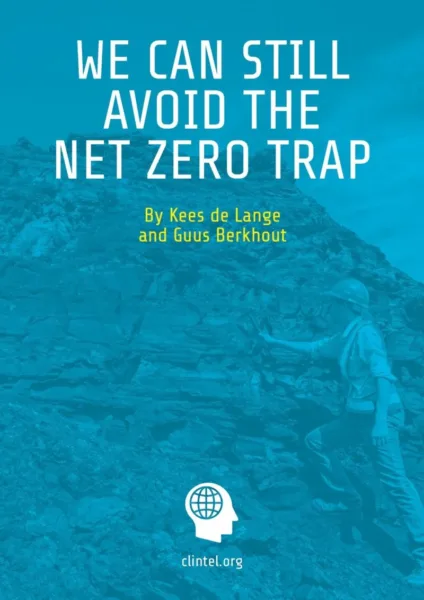
We can still avoid the Net Zero trap
Former politician prof. Kees de Lange and Clintel co-founder prof. Guus Berkhout state in a new essay that there is no reason to swim further into the Net Zero trap.
In the first part of their essay they show extensively that there is no climate emergency because of the emission of the greenhouse gas CO2. Amongst other things, they conclude that the focus of climate alarmists on CO2 is very one-sided. Furthermore, the dampening saturation effect that occurs with al greenhouse gasses, is left out deliberately in the fear-inspiring narrative.
The limitations of the current climate models are of such that, for now, they are no serious basis for climate policy. Their premise that the human contribution to CO2 production would be the recipe for a future climate disaster, is not supported by observations. Besides the saturation effect of CO2, the many assumptions on the very complex role of clouds is just as important. Clearly, clouds are the Achilles heel of climate science.
So, De Lange and Berkhout conclude that there is no climate crisis. We are however at the beginning of a self-made energy crisis. That is the focus of the second part of this essay. The reliability of demand-driven fossil energy is currently being sacrificed to supply-driven illusions, like wind and solar energy. The West is apparently prepared to risk prosperity for this. The rest of the world watches in amazement.
A new Dutch cabinet must stop the model-based doom stories about climate disasters and make new choices in energy policy. Amongst other things, De Lange and Berkhout argue for the further development of nuclear energy, with special attention given to the option based on the thorium cycle and its associated advantages. In the long term, this is the only rational way to adequately supply the world with energy. There is therefore no reason to swim further into the Net Zero trap. We can still go back.
Essay by Kees de Lange and Guus Berkhout
For the essay, click here
more news
No Evidence Weather Extremes Are Becoming More Frequent or Intense: (3) Floods
In a series of articles on extreme weather attribution, physicist Ralph B. Alexander examines whether observational evidence supports claims that weather extremes are becoming more frequent or intense. Following his previous article on droughts, this installment focuses on floods.
The Biggest Garbage Heaps in Human History
So much for the lies about clean, renewable, sustainable energy. Where will all the trash go? Cumulative global wind garbage (blades only) is projected to reach 200,000,000 tons by 2050 and cumulative global solar trash, 78,000,000 tons, says Paul Driessen.

“There Is No Such Thing as Renewable Energy”
Geologist, energy expert and educator Scott Tinker challenged some of the central assumptions behind the modern energy transition in his recent appearance on the popular podcast Triggernometry: “There’s no such thing as renewable energy.”