News

Advancing Freedom With Data: Debunking Catastrophic Greenhouse Warming
CO2’s greenhouse effect is the result of its interaction with the infrared of the electromagnetic spectrum, which is now largely saturated at today’s CO2 concentration of about 420 parts per million (ppm), say William Happer and Richard Lindzen. With so little unaffected infrared radiation left to interact with CO2 molecules, adding more of the gas is having a trivial effect and will produce even less warming in the future.
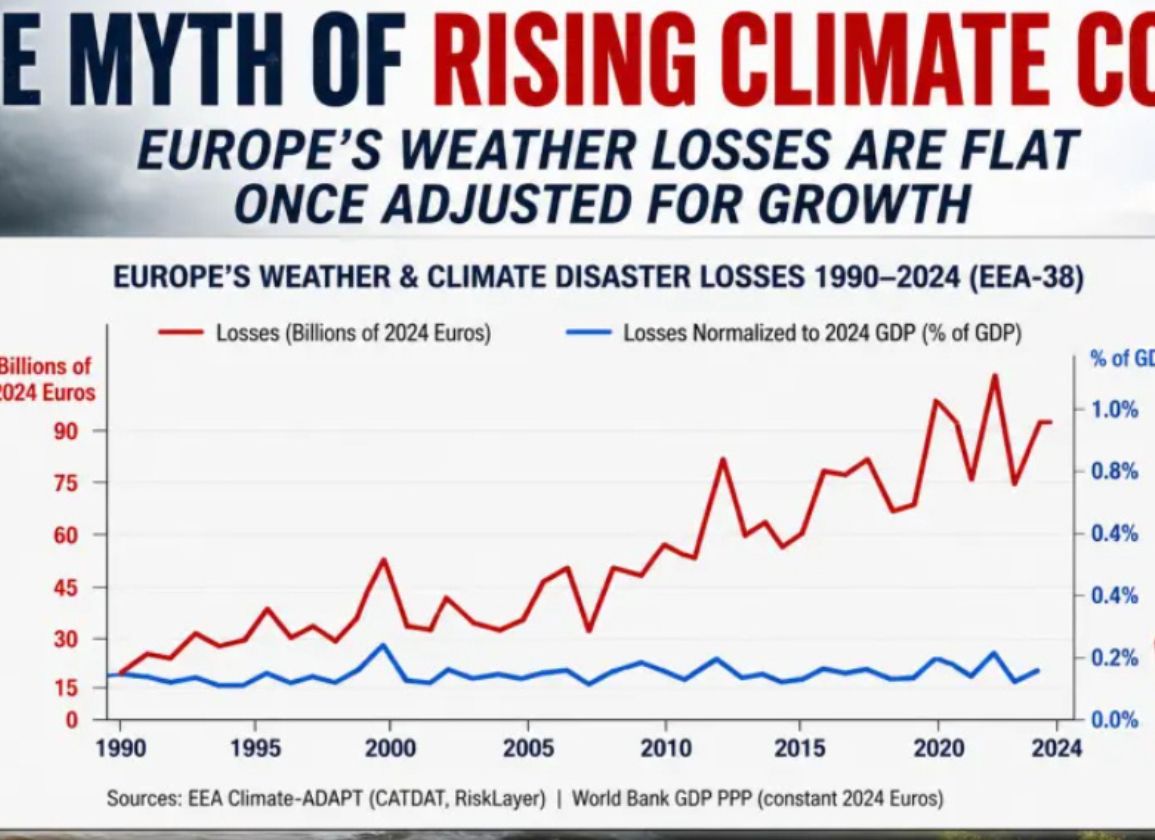
Europe’s weather losses are not rising (once adjusted for growth)
One of the most persistent claims in (European) climate politics is that weather disasters are becoming increasingly expensive because climate change is making extreme weather worse. But a new analysis by Roger Pielke Jr. shows that once economic growth is properly accounted for, Europe’s weather-related disaster losses have remained essentially flat since 1990.

Renewables still provided only 6% of global primary energy in 2025
The highly touted renewables provided only 6% of the world’s primary energy supply last year, according to the Statistical Review of World Energy, released earlier this week. Robert Lyman analyses the important overall statistical trends for the Friends of Science Society.

The Democrats’ Green Delusion: Using the Iran War to Double Down on Renewables
We can now see a familiar rhetorical manoeuvre from the Climate Establishment, says Tilak Doshi: Every crisis becomes a reason to accelerate the energy transition, and every inconvenient cost is attributed to insufficient commitment to the cause.
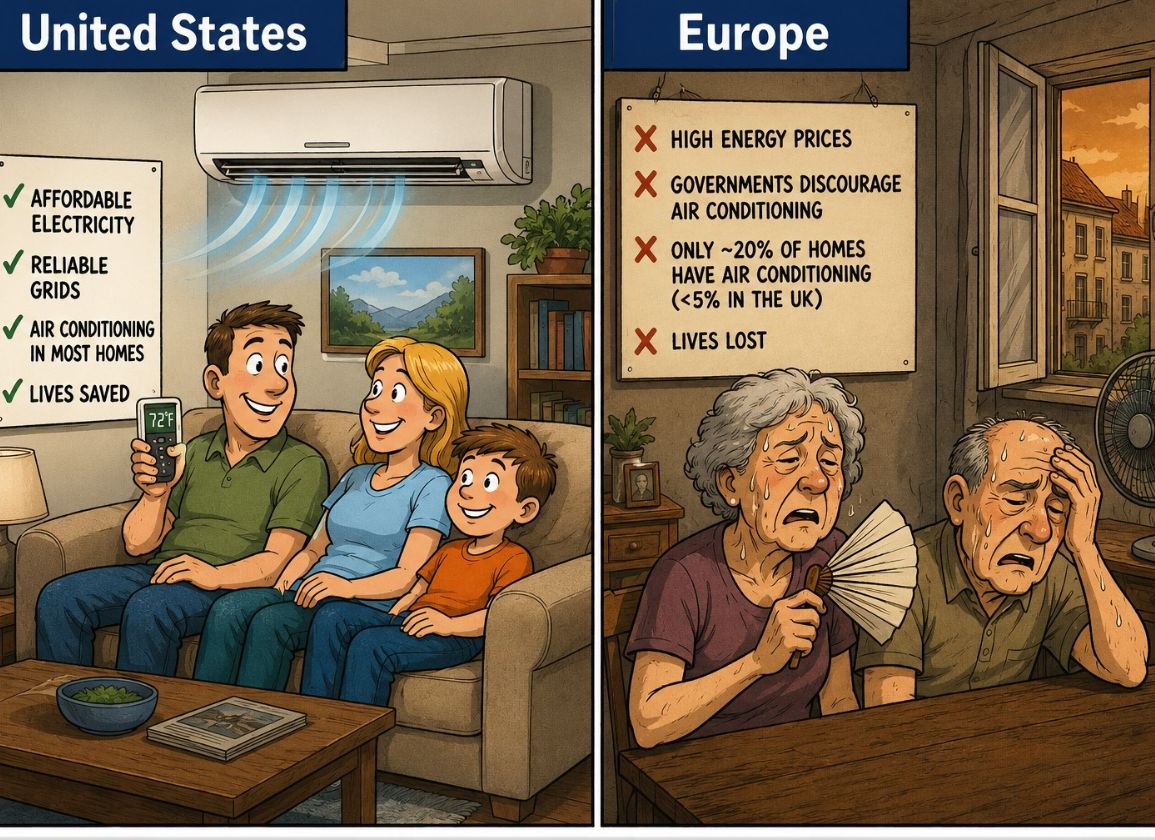
Europe’s Heat Deaths Are a Policy Failure, not a Climate Failure
More than 90 percent of American homes have air conditioning. Europe chose a different, deadly, path. It pays the price for ideology disguised as environmental policy, says Anthony Watts.

Vatican Newspaper Taints ‘Encounter of Faith and Reason’ With Climate Falsehood
L’Osservatore Romano, the official Vatican newspaper, has joined in the fearmongering of climate alarmists. But, as Frits Byron Soepyan explains, there is no basis for the newspaper’s sensationalism.
News
Advancing Freedom With Data: Debunking Catastrophic Greenhouse Warming
CO2’s greenhouse effect is the result of its interaction with the infrared of the electromagnetic spectrum, which is now largely saturated at today’s CO2 concentration of about 420 parts per million (ppm), say William Happer and Richard Lindzen. With so little unaffected infrared radiation left to interact with CO2 molecules, adding more of the gas is having a trivial effect and will produce even less warming in the future.
Europe’s weather losses are not rising (once adjusted for growth)
One of the most persistent claims in (European) climate politics is that weather disasters are becoming increasingly expensive because climate change is making extreme weather worse. But a new analysis by Roger Pielke Jr. shows that once economic growth is properly accounted for, Europe’s weather-related disaster losses have remained essentially flat since 1990.
Renewables still provided only 6% of global primary energy in 2025
The highly touted renewables provided only 6% of the world’s primary energy supply last year, according to the Statistical Review of World Energy, released earlier this week. Robert Lyman analyses the important overall statistical trends for the Friends of Science Society.
The Democrats’ Green Delusion: Using the Iran War to Double Down on Renewables
We can now see a familiar rhetorical manoeuvre from the Climate Establishment, says Tilak Doshi: Every crisis becomes a reason to accelerate the energy transition, and every inconvenient cost is attributed to insufficient commitment to the cause.
Europe’s Heat Deaths Are a Policy Failure, not a Climate Failure
More than 90 percent of American homes have air conditioning. Europe chose a different, deadly, path. It pays the price for ideology disguised as environmental policy, says Anthony Watts.
Vatican Newspaper Taints ‘Encounter of Faith and Reason’ With Climate Falsehood
L’Osservatore Romano, the official Vatican newspaper, has joined in the fearmongering of climate alarmists. But, as Frits Byron Soepyan explains, there is no basis for the newspaper’s sensationalism.